


What is Oxidation? Antioxidants, Oxidization, Free Radicals & Vitamin E

What are Oxidants?
Oxidants are unstable molecules that are missing one or more electrons.

Don’t worry, you do not need to know anything about chemistry. Just know that everywhere around us there are these unstable molecules in the air called Oxidants and they are missing an electron.
Since Oxidants are missing an electron they are constantly on the search for one.
A very common Oxidant you are probably familiar with is Free Radicals.

You have probably heard something similar to “this ingredient neutralizes Free Radicals” or “fights free radicals” or “prevents free radical damage”
This is because Oxidants are on the constant search for an electron to attach to. They can and will, attach to cells in our body and damage them. This is why Antioxidants are so important for us.
Antioxidants
The name says it, Anti-Oxidants. They eliminate or get rid of Oxidants.
Essentially Antioxidants sacrifice themselves to the Oxidants in order to protect our cells.
You can find Antioxidants in so many fruits and vegetables.

Antioxidants neutralize Free Radicals.
Antioxidants donate an electron to the free radical to stabilize it.

What is Oxidization?
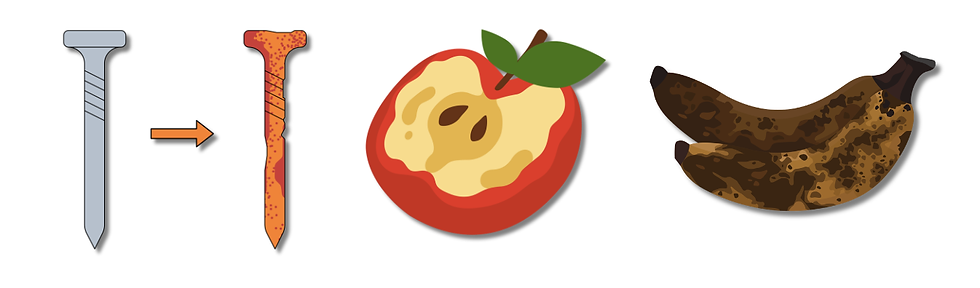
Do you have some bananas turning brown on your kitchen counter? Is the car you purchased a few years ago starting to show rust?
These are examples of Oxidation.
What is Oxidative Stress?
When we breath, we create free radicals. The damage caused by those free radicals is called ‘Oxidative Stress’.

Antioxidants are crucial to keeping the balance between oxidants and antioxidants. An imbalance of the two could lead to ‘Oxidative Stress’. So if you have more oxidants than you do antioxidants, this would be oxidative stress.
Let’s bring this back to the skin
The skin has it’s own natural antioxidant defense, but when the number of free radicals is greater than the skins natural antioxidant defense, immediate damage can be caused. This is why cosmetics include antioxidants and why they are so important for the health of skin. Antioxidants help with anti aging by protecting the skin.
Products themselves also need Antioxidants
Products can also oxidize. So they also need protection from antioxidants.
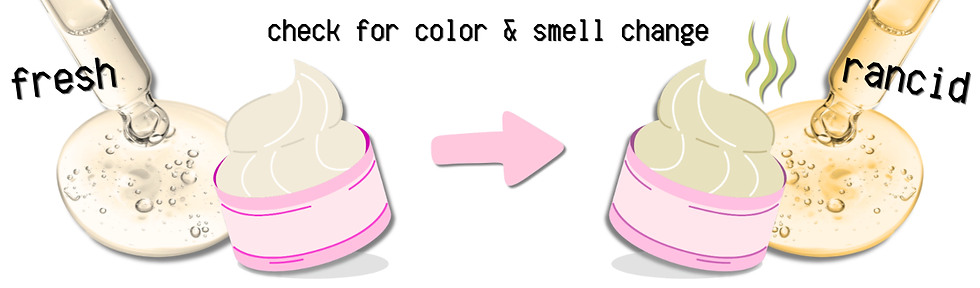
This is why it’s always recommended to add Vitamin E (tocopherols) to your natural oils. When you open your oils they are exposed to oxygen, which contains free radicals. These free radicals, damage the compounds in your oils and cause them to go rancid over time and smell off.
The Free Radicals in the Air can effect many other ingredients in your cosmetics as well. If you are using green tea extract in your moisturizer. Every time you open your moisturizer, that green tea extract is being exposed to oxygen(free radicals). This can cause your product to change in color over time as well.
Color changing & weird smells
If you are dealing with color changes or weird smells in your product, there is a high chance you are dealing with oxidization.
How to prevent Oxidization in products
Oxidization is a natural process and you can not prevent its, but you can delay it.
Vitamin E (mixed tocopherols) is the most popular ingredient to help protect against oxidization. Rosemary Extract also works, but Mixed Tocopherols is more common.
Vitamin E T-50 & Tocopherols 95% - can be used to prevent your natural oils from going rancid. Adds antioxidant protection to your formulation and will add antioxidant protection to skin, but degrades faster in formula.
Vitamin E Acetate - is used in cosmetics where there is no natural oils presents. (only emollient esters like Caprylic capric triglyceride, coco caprylate, and squalane for example) It adds antioxidant protection to your skin and is much more stable.
Other things that can help delay oxidation is using airless container and storing product in a dark container.

Not a Preservative!
Antioxidants are not preservatives. Actually Vitamin E can feed micro organisms. So you still need to add in a preservative for your aqueous products. (Products that contain water)
How much Vitamin E do I use?
I can’t say for sure how much you need for your specific product. I would follow your suppliers suggested usage rate for the Mixed Tocopherols you purchase as well. (There are different dilutions of mixed tocopherols.)
Add into your product below 40°C
Making Hot Pour products like Balms w/ Vitamin E
When making products like balms that may still be hot when you pour into your container, you need to add a higher amount of Mixed Tocopherols since some of the antioxidant properties will be burnt off. From my research it’s recommended to use 1-2% mixed tocopherols here.
Pro-Oxidization
On the opposite end, if you use too much antioxidants in your product you can cause a reaction where your product creates free radicals.
An ingredient that can help with preventing this are chelating agents. I’ve talked about these before.
Signs of pro-oxidation also includes yellowing/browning/turning orange and an off smell.
Experiment
I got this advice from the Institute of personal care science.
Make a batch of your product with 0.1% mixed tocopherols, a batch with 0.5% mixed tocopherols, a batch with 1% mixed tocopherols, and a batch with 2% mixed tocopherols.
Keep 1 of each stored at room temperature for 6 weeks
1 of each stored at 40°C for 6 weeks (Will need an Incubator)
& 1 of each stored at 55°C for 6 weeks. (Will need an Incubator)
Compare the color changes between each batch and the smell.
Obviously if you are just formulating for yourself, I wouldn’t be too concerned with figuring out the correct amount. Chances are, you will use the product up by the time it oxidizes. If it does end up oxidizing by the time you finish it, keep note of how much vitamin E you used and when it oxidized. Add in more vitamin E the next time you make it and keep note of when it oxidizes. You can try adding your product in a dark bottle or airless pump to help prevent further oxidation.
When selling, you need to be more cautious as you don’t want your products changing color over time as customers will think that means the product went bad and throw it out. Also if the product oxidizes that means the vitamins aren’t as potent and you don’t want your customer using a product that isn’t working at it’s full potential.
Oxidation is a normal thing that happens with all products, it’s our job as the cosmetic formulator to try and prevent it from happening for as long as possible.
Sources
Book: Discovering Cosmetic Science
Featuring Editors: Stephen Barton, Allan Eastham, Amanda Isom, Denise McIverty, and Yi Ling Soong.
Published by the Royal Society of Chemistry. 2021
Page 241 - 245


Comments